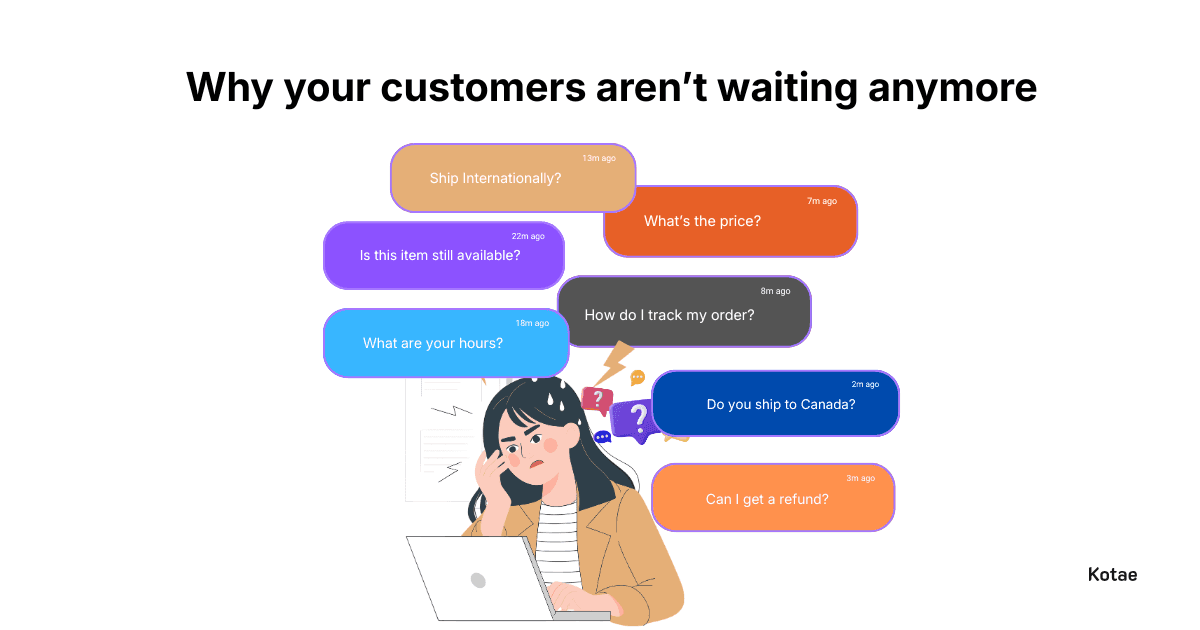
Quick answer: AI chatbots are reshaping how small businesses handle customer support, resolving up to 80% of routine questions automatically, delivering 24/7 availability, and turning support from a cost into a lead generation channel. In 2026, the businesses that have made this shift are pulling ahead. Most small businesses haven't moved yet.
Something Big Has Changed in What Customers Expect
Five years ago, a customer who didn't get a reply until the next morning would accept it. That's just not the case anymore.
More than 70% of customers now expect instant responses when they reach out to a business online. Not within an hour. Instantly. And if they don't get one, 62% of them will simply move to a competitor who responded faster.
For small businesses running lean, that's a tough expectation to meet manually. You can't be available at 11pm on a Saturday. You can't pause a client call to answer a shipping question. And you probably can't afford to hire someone just to manage the inbox.
This is exactly the gap AI chatbots are filling. And customer support automation is how small businesses are finally keeping up.
The Numbers Behind the Shift
If you're wondering whether this is a real trend or just hype, the numbers settle that pretty quickly.
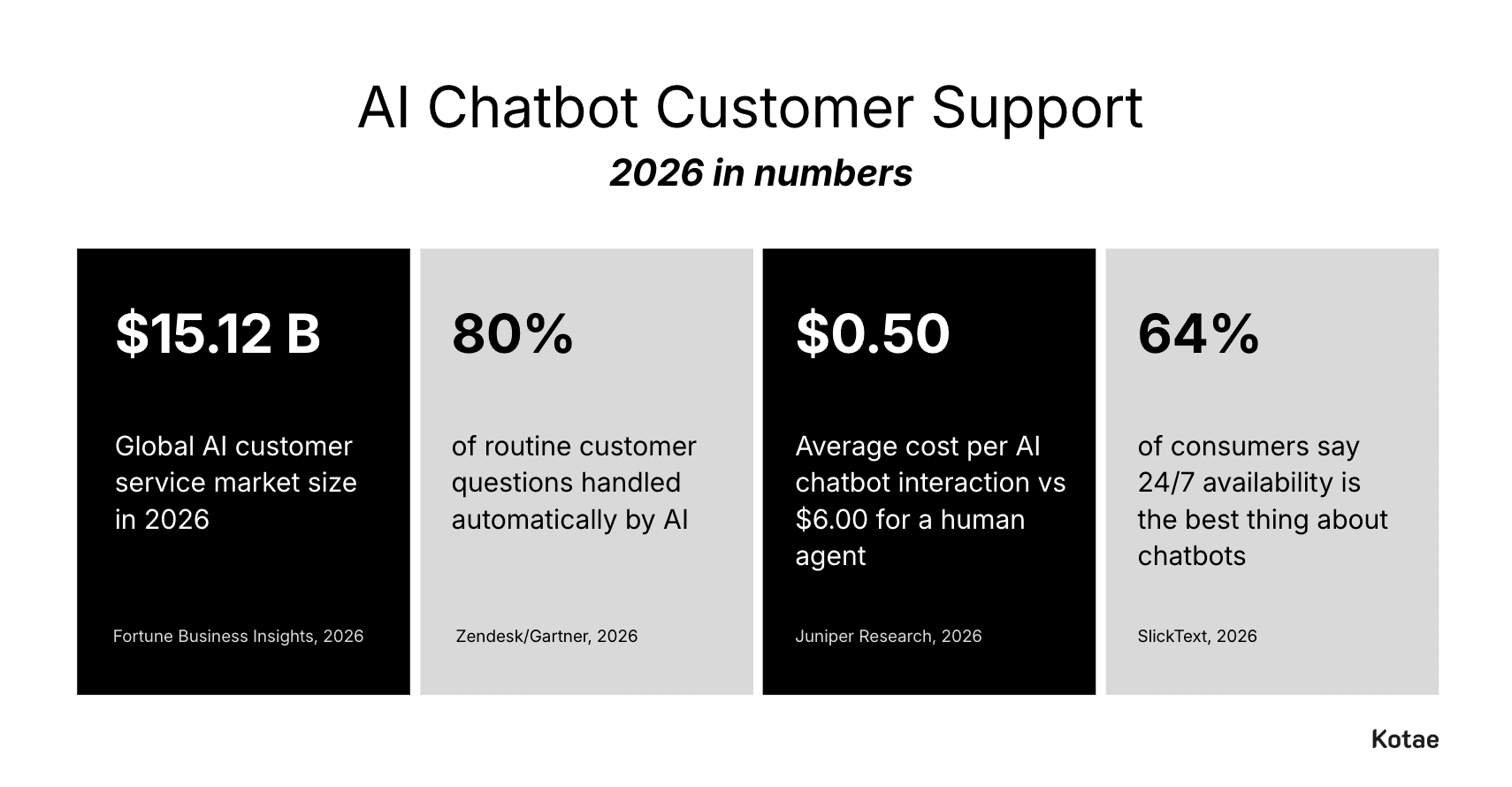
The global AI customer service market is on track to hit $15.12 billion in 2026. The AI chatbot market has grown 4.7 times since 2020. And 80% of companies are now using or planning to adopt AI chatbots for customer service.
Here's the part that's easy to miss though. Only 16% of small businesses currently have one in place.
That gap isn't because the technology doesn't work for smaller businesses. It's because most small business owners assume customer support automation is complicated, expensive, or designed for companies much bigger than theirs. None of that is true anymore. The technology has genuinely caught up with what small businesses actually need.
5 Ways AI Chatbots Are Changing Things Right Now
1. Your business stays open even when you're not
64% of internet users say round-the-clock availability is the most valuable thing a chatbot offers. An AI chatbot doesn't clock out. It answers questions on weekends, public holidays, and at 3am with the same accuracy it delivers at noon.
For a small business that can't staff an overnight support team, that's not a small thing. It's the difference between a customer who gets an answer and comes back, and one who moves on and doesn't.
2. How automated customer support handles the questions you're tired of answering
The average small business owner spends 10 to 15 hours per week on customer queries. A big chunk of that is the same handful of questions, phrased slightly differently, showing up every single day.
Automated customer support handles 60 to 80% of those routine inquiries automatically. Those hours don't disappear into a machine. They come back to you, to spend on the parts of the business that actually need your attention.
3. The cost difference is significant
A human customer service interaction costs around $6.00 on average. An AI chatbot handles the same interaction for about $0.50.
Businesses that deploy customer support automation report saving up to 30% on overall support costs. For a small business where every line item matters, that's a real difference.
4. It captures leads while you're off the clock
Most businesses think of customer support as a cost, something to manage and minimise. AI chatbots flip that completely. When a visitor lands on your site at midnight with a question, the chatbot answers it, starts a conversation, and collects their contact details. You wake up to qualified leads rather than missed chances.
55% of businesses using chatbots for marketing report higher-quality leads, and chatbot-powered funnels convert 2.4 times more customers than standard contact forms. Your support channel quietly becomes a sales channel.
5. Every customer gets the same good answer
Human support has a consistency problem that's hard to fix. The quality of an answer can depend on who's working, how far into their shift they are, and how many queries they've already handled that day.
An AI chatbot trained on your content gives the same accurate, on-brand response every single time, whether it's the first conversation of the day or the four-hundredth.
83% of consumers now rate their chatbot experiences as acceptable or good. The era of frustrating, useless bots is genuinely behind us. When a chatbot is trained on your actual content, it works.
How Does a Chatbot Actually Learn Your Business?
This is where modern AI chatbots differ most from what people picture when they hear the words "customer support automation."
Older chatbots ran from fixed scripts. Ask anything outside the prepared list and the bot would fail. That experience put a lot of people off the technology.
Modern AI chatbots work differently. They learn from your actual content: your website pages, your FAQs, your product documents, your uploaded files. Using a method called retrieval-augmented generation (RAG), the chatbot reads your knowledge base and gives accurate, natural responses based on what you have written about your business.
The result is a chatbot that can handle real questions, including ones phrased in unexpected ways, and knows when it does not have enough information to answer. In those cases, it collects the visitor's contact details and passes the conversation to you.
This is the difference between a bot that frustrates people and one that actually helps them.
What to Look for When Choosing a Chatbot
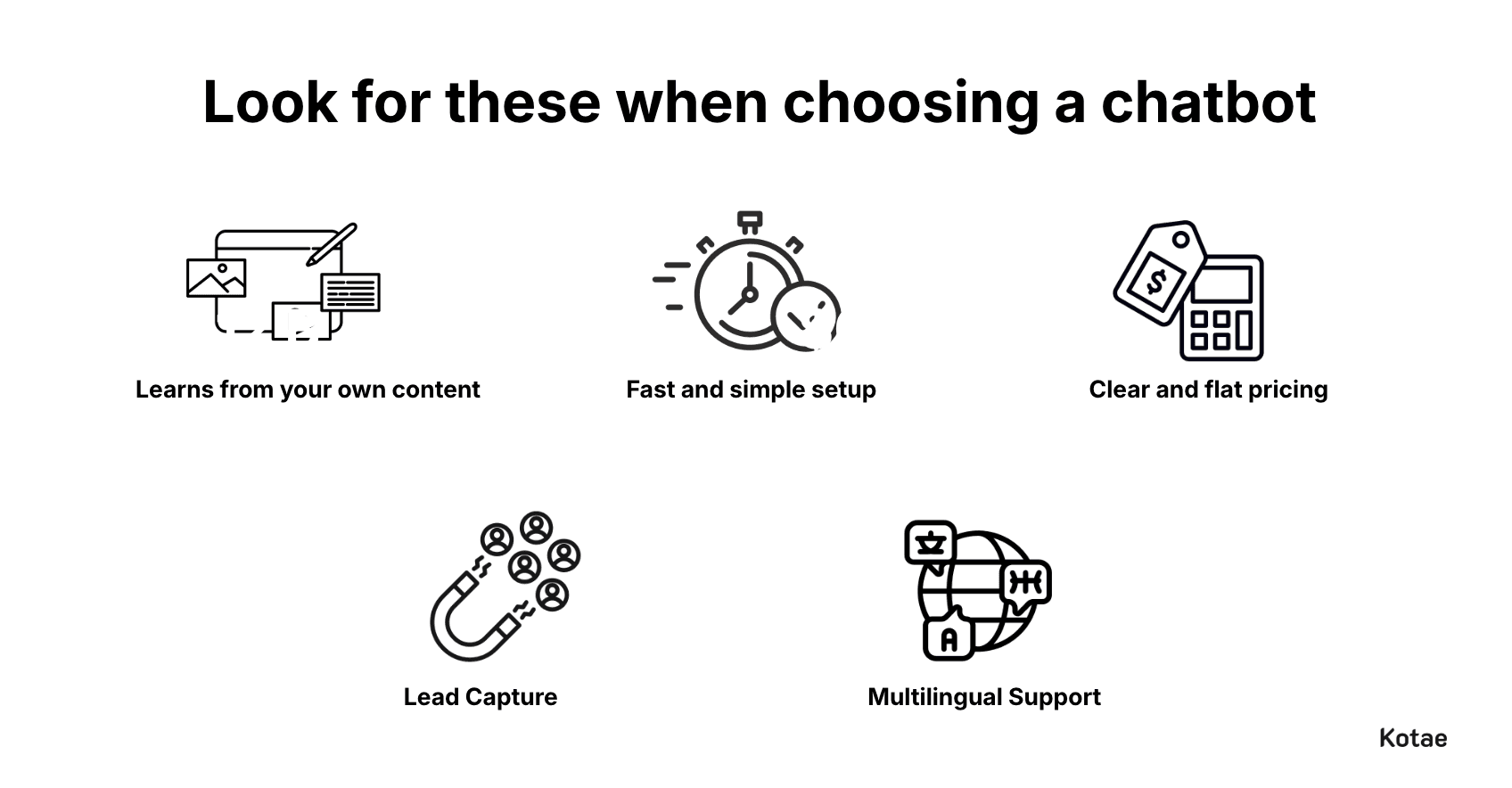
Not every chatbot delivers the same results. For a small business, these are the things that matter most:
It learns from your content. The chatbot should be trained on your website, your FAQs, and your documents, not generic internet data. Generic AI gives generic answers.
Setup should be fast and simple. If you need a developer to get started, it is the wrong tool. The right chatbot goes live in minutes without any technical help.
Pricing should be clear and flat. Watch out for per-message fees or per-resolution charges that make your costs unpredictable. Flat pricing lets you plan.
Lead capture should be built in. Your chatbot is not just a support tool. It should be collecting visitor information and alerting you when someone needs a follow-up.
Multilingual support should come standard. If your customers speak different languages, the chatbot should handle that automatically, without extra setup or cost.
The Opportunity That's Still Wide Open
64% of small businesses plan to adopt AI chatbots by the end of 2026. That means most of your competitors are either planning to make the move or already in the process. The businesses that move first build a head start that's hard to close.
Small businesses that have already moved to automated customer support are seeing 20 to 40% reductions in support costs and noticeably faster response times. The technology works. And the cost of waiting is very real.
Where Kotae Comes In
Kotae is an AI chatbot built specifically for small businesses. You train it on your website and documents in under 10 minutes. It supports 80+ languages automatically, handles up to 80% of routine inquiries on its own, and captures leads around the clock, all without a developer or any technical setup.
It was built by Tokyo Techies after they ran into exactly the problem described above: too many repetitive support questions, not enough hours to answer them. The result is a tool that makes customer support automation genuinely practical for small businesses, regardless of technical skill.
If you're ready to go from reading about this to actually setting it up, the next step is straightforward.
Read next: How to Automate Customer Support for Your Small Business (Step-by-Step Guide)
Frequently Asked Questions
How are AI chatbots changing customer support for small businesses?
What is customer support automation?
Do customers actually like talking to chatbots?
Are AI chatbots expensive for small businesses?
How many small businesses are actually using AI chatbots?
Want to see how Kotae works for your business? Start free at kotae.ai. No credit card. No developer. Set up in under 10 minutes.